From Father Steven - April 7, 2024

Father Steven Clemence • April 5, 2024


Dear Brothers & Sisters,


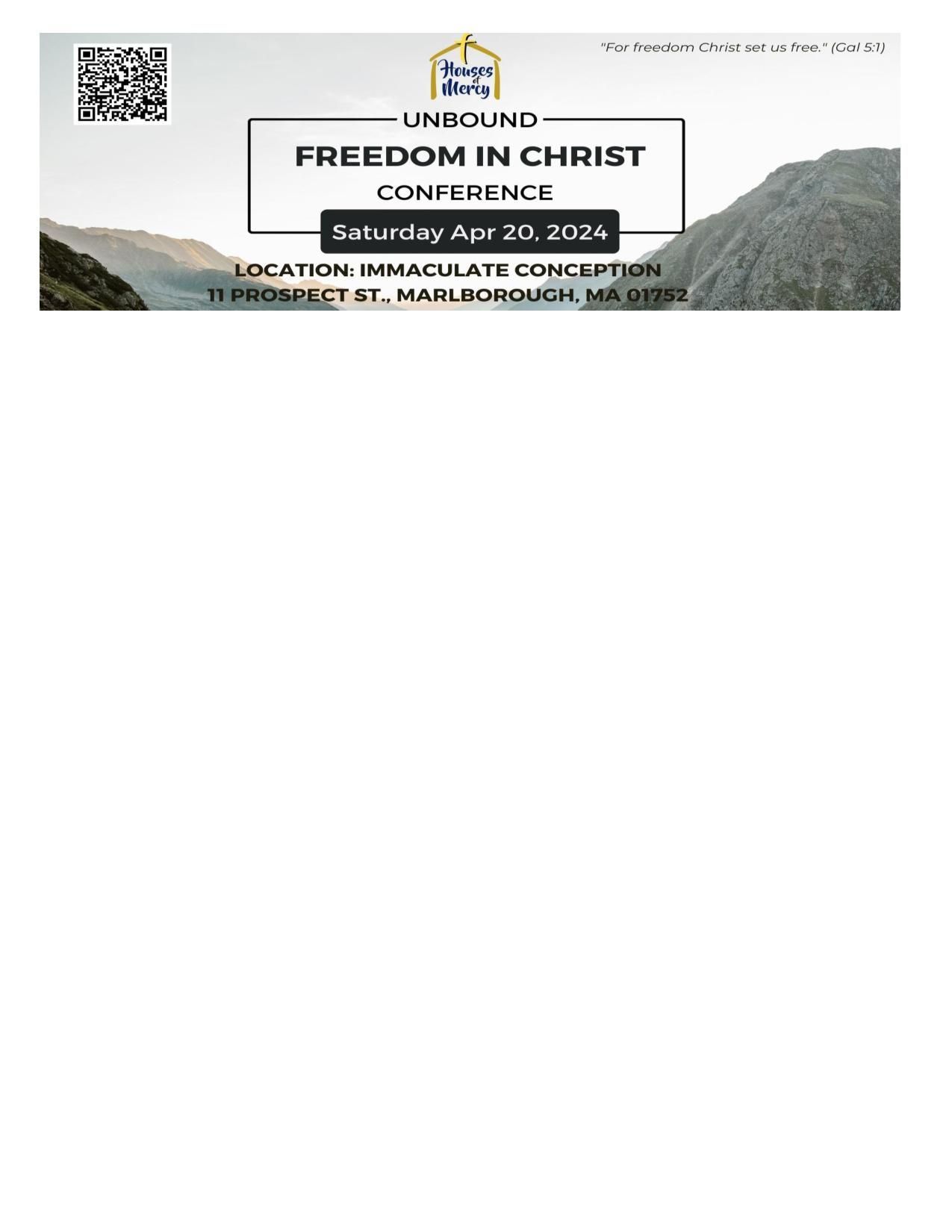
Please see the attached letter from Deacon Joe Cooley about the Unbound Conference here at the parish on April 20th.


God Bless,

Fr. Steven

—————————————————————————————-


Dear Immaculate Conception Parishioners, 


Blessed Easter and Divine Mercy Sunday! My name is Deacon Joe Cooley. I’m married and was ordained in 2016 to the permanent diaconate for the Archdiocese of Boston. I’m passionate about seeing people come alive in their identity and gifting as a son or daughter of an amazing Father. To that end, I’ve founded the nonprofit HOMe Ministries (Houses of Mercy). We teach, equip, and activate people in freedom and the ways of the Gospel and seek to move faith from the head to the heart and home. I am excited to see what the Lord is stirring at Immaculate Conception. This is my favorite time of year when we celebrate the Lord’s goodness and victory over Satan, sin, and death–for love of you and me! This season of the Church calendar is a profound time of grace in which the Lord is inviting us deeper into healing and freedom in mind, body, and spirit. Jesus died with what we deserve so that we might live with what he deserves–a life filled with an abundance of joy and all the fruits of the Holy Spirit! Thank you, Lord! I want to take this opportunity to thank you for your warm welcome during the Lenten Mission this past March 12-14. In my short three evenings with you, I experienced the beauty of the church building and even more, the beauty of the people of Immaculate Conception. The Lord touched us powerfully as we encountered his goodness! Thank you Jesus, and thank you all!


I also want to personally invite you to an Unbound Freedom in Christ Conference on Saturday, April 20 at the parish. This is NOT just another “event” but an opportunity to allow the Lord to bring fresh healing and freedom to our hearts! The following testimonies demonstrate the possibilities from a wide variety of people who have attended a conference or experienced Unbound prayer:


· “This is the best day of my life.” –A 10-year-old boy

· “[The Unbound prayer session] was incredibly powerful and, for the first time in a long time, I could laugh with genuine pleasure with my family tonight and have a conversation with a friend without growing distracted by fear and anxiety. The feeling of being under attack has abated and I can breathe.”

· “I arrived home exhausted. I felt like I haven't slept in decades. I think the anxiety from all the years of torment left me today. I felt peaceful and in need of resting with the Lord. I feel fresh and rested now and ready for where the Lord is going to take me next.”

· “I believe for the rest of our lives, this conference will be the linchpin we point to that saved our marriage!”

"Jesus has set me free! And, I did not think I was in dire need of help. I only knew the Holy Spirit was prompting me to ask." Use the QR code to learn more details and register (or register at the door) for the conference. Continue reading next to learn more about Unbound and the Lord’s will that you and I experience and live in deep freedom in our lives.
By Father Steven Clemence January 9, 2026
Dear Brothers and Sisters, This weekend we celebrate the Feast of the Baptism of the Lord, which brings the Christmas season to its conclusion. On Monday, we enter Ordinary Time. On this occasion, I would like to reflect with you on the meaning and importance of Baptism. In our baptism preparation classes, I often ask parents a simple question: What is Baptism? I invite you to ask yourself the same question. After a long silence, words usually begin to surface—original sin, the Holy Spirit, entering the Church. The Catechism of the Catholic Church offers a beautiful definition in paragraph 1213: “Holy Baptism is the basis of the whole Christian life, the gateway to life in the Spirit… the sacrament of regeneration through water and the word.” Through Baptism, God forgives original sin, gives us new life in the Holy Spirit, incorporates us into Christ and His Church, regenerates us, and makes us His adopted children, sharers in His divine nature. Practically speaking, as St. Paul teaches, the old person dies in the waters of Baptism, and a new person rises—conformed to Christ, filled with grace, and called to live in His likeness.  However, Baptism is not a magical ritual. It is not simply a matter of “going through the motions” and then moving on with life. The graces we receive must be nurtured in order to grow. The divine life within us is like having a Ferrari parked in the garage but never taking it out for a drive. It is something so extraordinary that, in the early Church, people were willing to die simply to receive Baptism. To share in the life of Christ makes us capable of loving as He loved, forgiving as He forgave, trusting in the Father, and hoping beyond all hope. In the early Church, Baptism was preceded by a long period of formation called the Catechumenate, during which people learned how to live as disciples of Christ. Today, especially with infant Baptism, the Church reminds us that this formation must continue after the sacrament is received. The Catechism (no. 1231) speaks of the need for a post-baptismal catechumenate—a lifelong formation in faith. It is not enough simply to receive the sacraments; we must allow them to shape our lives. While our parish strives to offer solid faith formation for our children, this formation often ends with Confirmation. But our faith journey cannot stop there. We all need ongoing formation. Here at our parish, we offer opportunities for adult faith formation through talks and through the itinerary of faith of the Neocatechumenal Way. The Church also provides godparents at Baptism, who are called to be guarantors and witnesses of the faith for the child. This is why the Church is rightly serious about the requirements for godparents. They must have received all the sacraments of initiation and strive to live a sacramental life—attending Mass regularly, receiving the sacraments, and living according to the teachings of Christ and His Church. Godparents are meant to be role models and guides in the Christian life. If they do not walk this path themselves, they cannot effectively guide their godchildren in faith. Finally, this leads to the most important question: How do we live our Baptism? Do we act and live as children of God? Do we truly believe that we have a loving Father who provides for us; a Savior who died to forgive our sins and give us new life; a Holy Spirit who guides us and reminds us of all that Jesus taught; a Church who is our Mother, guiding us on our journey; the communion of saints; that all sins can be forgiven when we desire to sin no longer; the resurrection of the body; and heaven? It is never too late to begin again. We are not called to follow the values of our culture, but the values of Christ. The commandments and the Gospel have not changed—why should our faith change? Perhaps this new year is the moment for a fresh start. That divine nature we received at Baptism—like a powerful Ferrari ready to be driven—is waiting to lead us along the path of God. It is never too late. Let us take advantage of this new beginning and start again, living our lives as they were meant to be lived. God Bless, Fr. Steven
By Father Steven Clemence January 2, 2026
Dear Brothers and Sisters in Christ, “We three kings of Orient are, bearing gifts we traverse afar.” This is a well-known song that we sing and hear every year during this season. Yet, I wonder how often we pause to reflect on the meaning of these words. As we celebrate the Feast of the Epiphany this weekend, I would like to reflect on three aspects of the Magi: they left their homes, they traveled from afar, and they returned by a different way. There are many traditions and even myths surrounding the wise men. Were they truly kings? Were they astronomers? Where did they come from? What gifts did they bring? When exactly did they arrive in Bethlehem? While many of these questions remain open to speculation, there are a few things we know for certain. As the song reminds us, they were men who journeyed from afar, bearing gifts for the Christ Child. Perhaps we imagine their journey in modern terms: three men meeting at an airport, boarding a plane to Israel, then taking a transfer or an Uber while following a GPS pin to the child. But in reality, their journey was nothing like that. These men risked their lives. They faced the harsh elements of the desert and the many dangers of the road—wild animals, bandits, and countless unknowns. They had to renounce the comfort of their homes and the security of familiarity. Yet they were confident in the sign they had seen in the sky. They were people attentive to God, waiting for a word that would point them in the right direction. Pope Benedict XVI once reflected on this profound moment, saying: “The Magi set out because of a deep desire which prompted them to leave everything and begin a journey. It was as though they had always been waiting for that star. It was as if the journey had always been part of their destiny, and was finally about to begin.” As beautiful and inspiring as their story is, we are invited to place ourselves within it. What if we were among them? Would we spend long hours searching for a sign from God? Would we be willing to leave behind the comfort of our lives to begin such a journey? What would we be willing to risk in order to encounter the Messiah face to face? These are questions worth asking, because God desires to reveal himself—have an epiphany—in our lives every day. The real question is whether we desire it enough: what we are willing to leave behind, and whether we are willing to face the challenges that come with following him. Each day we bring many intentions before God. Certain situations reveal our lack of charity, our pride, or other sins, prompting us—after honest examination—to ask God for help. The same can be said of any vice or weakness. Yet the question remains: how far are we willing to go to grow in humility, charity, and holiness? The Magi understood that without the Messiah, everything else lost its meaning. Without a personal encounter with Jesus, all the riches of the world amounted to nothing. They seemed to know this deeply. But do we? Once again, Pope Benedict offers guidance: “The better you know Jesus, the more his mystery attracts you. The more you discover him, the more you are moved to seek him. This is a movement of the Spirit which lasts throughout life.” We also know that the Magi “returned to their own country by a different way.” Their story did not end in Bethlehem; they still had a long journey home, facing the same dangers once more. This time, however, they no longer followed a star. After encountering Christ, the light now lived within them. Later, Jesus would affirm this truth when he said that we are the light of the world. In baptism, we too receive the light of Christ. Pope Benedict describes the Magi’s new mission in these words: “Their task was to guard and nourish it in the constant memory of Christ, of his Holy Face, of his ineffable Love.” This is the mission of every Christian. And I would go even further: we are not only called to guard and nourish the love of God within us—we are also called to spread that love to all those around us.  God Bless, Fr. Steven